

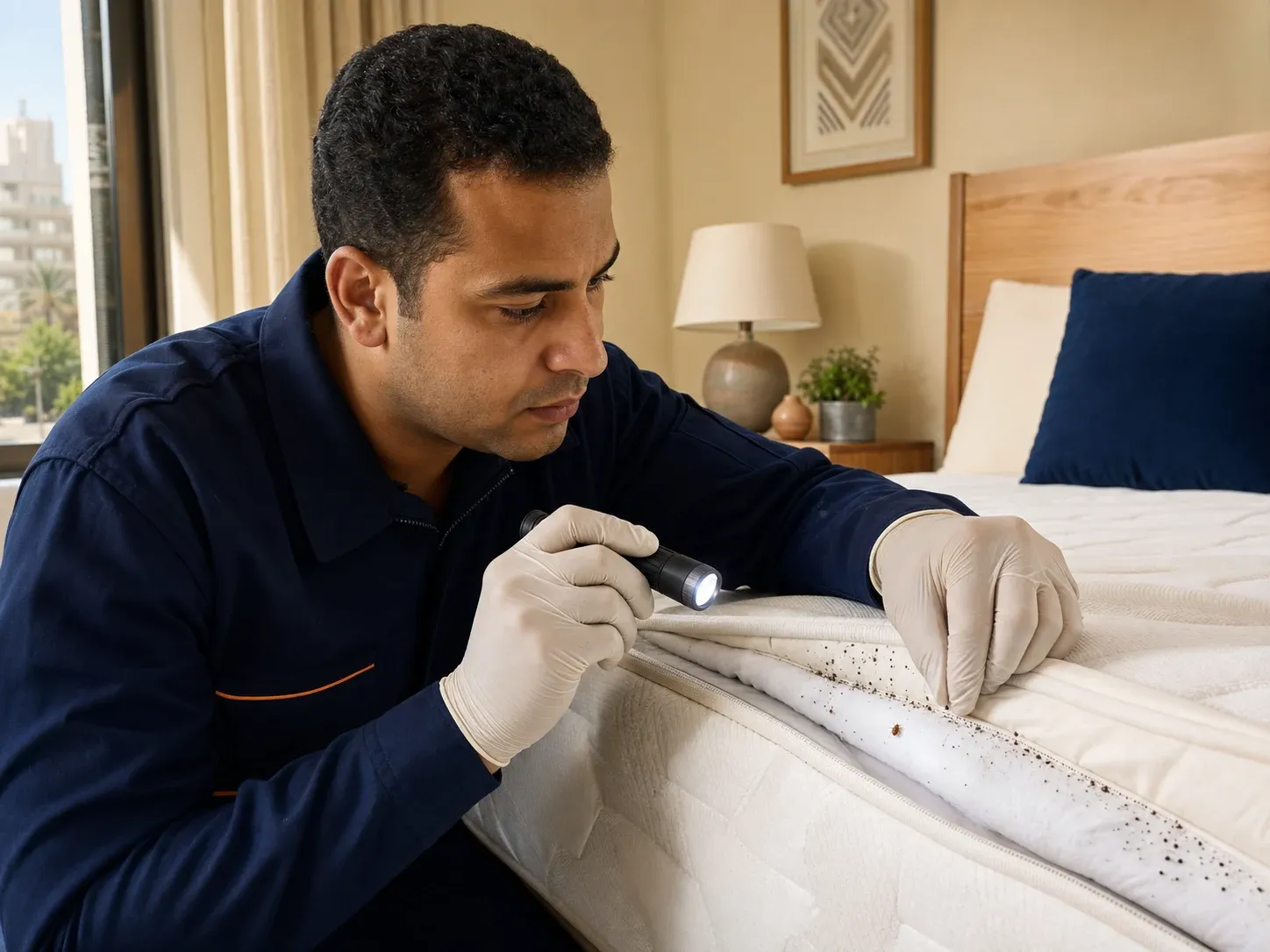
You woke up with a neat row of red, itchy bites on your arm. There are small blood spots on the sheet, and brown specks packed into the mattress seams. That is bed bugs. Clearing them for good means reaching the insects and their eggs in every hiding place, then coming back to close the hatching cycle. One pass with an aerosol does not do it.
Bed bugs are not just an insect that bites. They take your sleep, and they multiply faster than most people expect. This guide covers how to confirm it really is bed bugs, where they hide in an Egyptian flat, why they return after you spray, and what ends the problem.
Contents
- How to be sure it is really bed bugs
- What bed bugs look like, and how fast they breed
- Where bed bugs hide in your home
- What bed bugs do to your sleep and your skin
- Why they come back after DIY spraying
- DIY treatment vs professional treatment
- Washing, freezing and encasement: your support work
- How to keep them out (travel and second-hand furniture)
- When to call a professional straight away
- What does bed bug treatment cost?
- Frequently asked questions
How to be sure it is really bed bugs
Before you buy anything or pull the bedroom apart, confirm what you are dealing with. Plenty of people spray for mosquitoes for months while a bed bug population sits quietly in the mattress seams. These are the signs that settle it.
1) Bites in a line or a tight cluster
The clearest sign. A bed bug feeds several times along the same path, so you get three or four bites in a straight line or a small arc. Mosquito bites land randomly. Bed bug bites look organised, and they show up on whatever skin was uncovered while you slept: forearms, neck, shoulders, upper back.
2) The itch is worst in the morning
You rarely feel a bed bug feeding. Their saliva contains a mild numbing agent, so you sleep through it and wake to itchy marks that were not there the night before. If the itching peaks when you open your eyes and eases through the day, take that pattern seriously.
3) Blood spots on the sheet
This turns suspicion into near certainty. You turn over in your sleep, crush a bug that has just fed, and it leaves a small rust-coloured smear on the sheet. Find those in the morning and check the fabric around them closely.
4) Shed skins and dark specks
Bed bugs leave a trail once you know what to look for:
- Tiny black dots along the mattress seam, as if someone flicked a ballpoint pen. That is their waste, digested blood.
- Pale translucent shells, the skins they shed as they grow, usually collected in cracks and corners.
- Small white eggs, roughly the size of a pinhead, glued into seams and joints.
5) The smell
In a heavier infestation the room develops a sweet, stale smell, often described as damp almonds or wet metal. It comes from the bugs’ scent glands. By the time you can smell it, the numbers are high.
Quick check: bites in a row, blood spots on the sheet, brown specks in the mattress seams. If all three are there, stop guessing. That is bed bugs, and it needs treatment, not time.
What bed bugs look like, and how fast they breed
Bed bugs are exceptional at hiding and uncomfortably fast at breeding. That is why people underestimate the problem in week one and regret it in week five.
What they look like at each stage
An adult bed bug is about the size of an apple seed, 4 to 5 mm, reddish brown, with a flat oval body before it feeds. After a blood meal it swells and darkens. Bed bugs do not fly or jump. They walk fast and squeeze into gaps narrower than you would believe.
The young ones, called nymphs, are paler and almost translucent. The smallest are easy to look straight at and miss. The eggs are white, tiny and cemented into corners, which is why they survive most amateur treatments.
The life cycle that takes over a home
A single female lays one to five eggs a day and two hundred or more over her life. Eggs hatch in about a week to ten days. The nymph passes through five growth stages before it can breed, and in warm conditions that takes five to six weeks.
Here is the part that matters in Egypt: heat speeds all of this up. A cycle that takes two months in a cool European flat compresses into a few weeks in a Cairo summer, especially in a bedroom sitting at 28 degrees overnight. Every week you postpone becomes a noticeably larger population.
How long they survive without feeding
An adult bed bug can go months without a blood meal, and in cool conditions closer to a year. Locking up the flat and travelling for the summer does not starve them out. They sit still in the cracks and wait for the door to open.
A family shuts up a New Cairo flat in June, or a North Coast chalet in October, comes back, sleeps one night, and the bites start again. Nothing new arrived. The old population waited.
Where bed bugs hide in your home
The name is misleading. Bed bugs shelter in any tight gap close to where you sleep, so they can feed at night and be back before you stir. Miss one hiding place and the colony rebuilds from it. Check these with a torch:
- Mattress seams, piping and corners, especially underneath the edge trim and beneath the label.
- The bed frame, timber or metal, particularly where two pieces meet and around screws and bolts.
- Sofas and armchairs, under the cushions, along the seams, and behind the upholstery fabric.
- Behind the headboard, and on the wall directly behind it.
- Cracks in walls and floors, and behind wallpaper that has started to lift.
- Behind sockets and light switches, which are dark, warm and almost never checked.
- Bedside tables and drawers, especially the internal timber joints.
- Long curtains that touch the floor beside the bed.
- Behind picture frames, mirrors and wall clocks hung near the sleeping area.
Bed bugs are lazy travellers. The closer you get to where someone sleeps, the higher the odds of finding them. Left alone, they push into other rooms and a bedroom problem becomes a whole-flat problem.
Older buildings add one more route, and Zamalek, Heliopolis and downtown Cairo have plenty of them. Bed bugs move between flats through shared pipe risers, ducts and gaps around service pipes. If a neighbour has an untreated problem, your flat is exposed no matter how carefully you keep it.
What bed bugs do to your sleep and your skin
People say it is only bites and they will pass. The damage runs deeper than the marks on your arm.
Broken sleep and the stress that follows
This is the worst of it. Once you know something is feeding on you at night, sleep itself becomes a source of anxiety. Every small itch pulls you awake. You get up at 2am with a phone torch and lift the sheet to check. The result is weeks of broken sleep, exhaustion through the day, and a shorter temper with everyone around you. For many people the mental toll is heavier than the physical one, and it is nothing to be ashamed of.
Itching and broken skin
Bites can itch intensely, and scratching makes it worse. Some people react far more strongly than others: larger swelling, spreading redness, occasionally small blisters. Children come off worst, because their skin reacts more and because they scratch in their sleep. Bed bugs are not known to spread disease the way mosquitoes can, but a bite scratched open can become infected. If that happens, or a reaction is severe, see a doctor rather than guessing.
The social side
Then there is the part nobody wants to discuss. A friend stays the night. You travel and carry bed bugs in your suitcase to someone else’s home. Embarrassment makes people hide the problem instead of solving it, and hiding it is exactly how it reaches the flat next door.
Why they come back after DIY spraying
This is the question we hear most: “I sprayed the flat three times and they are still here, why?” The answer is not that you were careless. Spraying at random is the wrong method. Here is where it breaks down.
1) Surface spray does not reach the eggs
Eggs are the whole problem. Most retail products kill adult bed bugs out in the open. The eggs sit deep in cracks and seams, and the shell resists most of what you can buy. You think you have finished. A week later they hatch and you are back where you started. Treatment has to be repeated at the right interval to catch the next generation before it lays.
2) The product goes in the wrong places
People spray the top of the mattress and mist the floor. The bed bugs are not there. They are inside the seams, behind the headboard, in the timber joints, behind the socket plate. If the product never reaches those gaps, the colony sits it out untouched.
3) The wrong product, or too weak a concentration
Some products repel bed bugs rather than kill them. The population leaves the room you treated, moves next door or into a neighbouring flat, waits, and comes back. Resistance to older active ingredients is well documented too, so a treatment can leave a strong smell behind and almost no dead bugs.
4) A live source outside your flat
If the infestation is arriving from a neighbour through shared risers or a common wall, you can treat your own flat repeatedly and still get reinfested. The source has to be dealt with, not just the symptom. That sometimes means treating two or three flats at once. Raise it with the building manager rather than fighting it alone.
5) No follow-up visit
Even a correct first treatment fails on its own. Without a second visit around two weeks later to catch what hatched from surviving eggs, the cycle completes and starts again. The follow-up is not an upsell. It is half the treatment.
The short version: bed bugs do not return because they are indestructible. They return because random spraying leaves the eggs and the hiding places intact. Treating half a cycle costs weeks and money and produces nothing.
DIY treatment vs professional treatment
Fair question: handle it yourself, or bring someone in? Here is an honest picture of both.
DIY: when it works and when it does not
If you have caught it very early and found one or two bugs, some steps genuinely help:
- A hot wash for all clothing, bedding and linens, at 60 degrees or above.
- A steamer run slowly along mattress seams and sofa seams. Heat kills bugs and eggs where they sit.
- Thorough vacuuming of every seam, joint and crack, with the bag sealed and taken straight out of the flat.
- Mattress encasement, a sealed cover that traps whatever is inside until it dies.
Those steps are worth doing. They rarely finish the job once the infestation is past its earliest stage. Retail products are weak, nothing you own reaches inside a wall void or a timber joint, and finding every hiding place takes practice. The usual outcome is weeks of effort, money spent, and bed bugs still there.
Professional treatment: what changes
A trained technician does several things you cannot do from a supermarket shelf:
- Inspects and diagnoses first, mapping how far the infestation has spread and where every hiding place is, before anything is applied.
- Uses licensed pesticides, safe around children and pets once dry, at a concentration that reaches the harbourages instead of sitting on the surface.
- Uses injection and crack-and-crevice equipment that puts product inside seams, joints and voids your hand cannot reach.
- Targets each source individually, rather than fogging a room and hoping.
- Returns for a follow-up visit that closes the egg-hatching cycle and confirms the population is gone.
- Puts a warranty in writing, so you are covered if anything reappears.
That is how our bed bug control service is built. We treat the mattress, sofa, frame joints and cracks with a product that reaches the bugs and their eggs, then come back to verify. We have worked across Egypt for over 12 years, in more than 8,500 homes and facilities. Our team speaks English, so you can describe the problem and follow the plan without anything getting lost. You will know the price before anyone touches anything.
If the infestation is old, spread across more than one room, or keeps coming back, professional treatment is not an indulgence. It is the cheaper and faster route out.
Washing, freezing and encasement: your support work
Even with professional treatment, there is work at home that multiplies the result and cuts off the bed bugs’ options.
Hot washing
Heat is the most reliable weapon you have at home. Wash all clothing, sheets, pillowcases and covers at 60 degrees or above, then tumble dry on high heat. That kills bugs and eggs together. Anything that cannot be washed goes into a hot dryer on its own for thirty minutes, which is often enough by itself.
Freezing
Items that will not survive a hot wash, such as toys, delicate fabrics and books, can go into the freezer instead. Deep cold kills bed bugs too, but it needs far longer. Seal the item in a bag and leave it in a properly cold freezer for several days.
Encasement and isolation
- Encase the mattress and pillows in bed-bug-proof covers. The cover traps anything already inside until it dies and stops new bugs colonising the seams.
- Pull the bed away from the wall. Nothing but the legs should touch the floor: no trailing bedding, no storage boxes underneath.
- Bag clean clothing in sealed plastic until treatment is finished, so it does not become a fresh hiding place.
Disciplined vacuuming
Vacuum daily through the treatment period: seams, corners, behind furniture, along skirting boards. Seal and remove the bag every time. It will not solve the problem alone, but it cuts numbers and speeds the treatment up.
One warning: do not move an infested mattress or sofa into another room, and do not put it out on the landing. Both spread the infestation. Leave everything where it is until treatment is complete.
How to keep them out (travel and second-hand furniture)
Once the flat is clear, the job is keeping it that way. Bed bugs enter homes by a short list of known routes. Close those and you can stop thinking about it.
After travel and hotel stays
Travel is the number one way bed bugs reach a home. If you fly in and out of Egypt often, your exposure is higher than average. A few habits cover it:
- Check the hotel room before you unpack. Lift a corner of the sheet and look along the mattress seam and the headboard for dark specks or small stains.
- Never open your suitcase on the bed. Use the luggage rack, pulled away from the wall, or the bathroom floor, which is smooth tile and unattractive to bed bugs.
- Open the case outside the bedroom when you get home. The balcony or the stairwell is ideal, not the wardrobe.
- Wash everything hot immediately, including clothes you never wore, and keep the case itself away from bedrooms until you are satisfied it is clean.
Second-hand furniture
Used furniture, especially mattresses, sofas and timber bed frames, is a serious risk. Before any second-hand item comes into the flat:
- Inspect it closely under a strong light, along every seam, joint and crack.
- Never buy a used mattress. No inspection is thorough enough to make that a sensible risk.
- If you must take a used timber piece, steam it or have it treated before it crosses the threshold.
The same goes for furnished rentals. Moving into a furnished flat in Maadi, Zamalek or Sheikh Zayed? Spend ten minutes with a torch on the mattress seams and headboard before you sleep on it. Far easier to raise with a landlord on day one than in month three.
Ongoing prevention at home
- Seal cracks in walls and floors and around socket boxes to close off hiding places.
- Reduce clutter around the bed. Fewer boxes and bags means fewer places to hide.
- Check the bed periodically, particularly after guests have stayed or after you return from a trip.
- If a neighbour in your block has bed bugs, tell the building management and push for the adjoining flats to be treated at the same time. Otherwise the source keeps sending them back to you.
Prevention costs a fraction of treatment. Two minutes with a torch after every trip saves weeks of misery.
When to call a professional straight away
Some situations leave no room for experimenting, and every week of delay makes the job harder and more expensive. Call straight away if:
- You have found bites in a row, blood spots and brown specks together. That is confirmed, not suspected.
- Bed bugs have appeared in more than one room, not just the main bedroom.
- You have already sprayed once or more and they came back. That is proof the method is not working.
- There are young children or elderly people in the home who are being bitten and reacting.
- You are seeing bed bugs during the day. They come out in daylight when numbers are high enough to drive them to feed early.
- You can smell that sweet, stale odour in the bedroom, which points to an advanced infestation.
The earlier you catch it, the shorter and cheaper the job. A small, contained infestation is usually resolved with one treatment and one follow-up. One left for months takes far more work. We cover all 27 governorates, with an average response of around 60 minutes. Get in touch and book a visit, describe what you are seeing, and we will inspect and diagnose the property before anything is applied.
What does bed bug treatment cost?
There is no single number, and anyone who quotes a final price over the phone without seeing the property is guessing. What it actually depends on:
- The size of the property. One bedroom is not the same job as a full flat, and a flat is not a villa.
- How far it has spread. Bed bugs confined to one bed cost less than bed bugs established across several rooms.
- The type of treatment. Targeted spray, injection, steam, or a combined plan using all three.
- How many follow-up visits are needed to close the egg cycle safely.
How we set the price transparently
This is why we inspect first. We confirm what we are dealing with and how far it has spread, then give you a clear written quote before any work begins. No hidden charges, no pressure. You approve the price first, and the decision to go ahead is yours. If someone has given you vague numbers before, that is the part to hold us to.
The number that actually matters: the warranty
The most important figure is not the price, it is the warranty. A cheap treatment that fails after a month means you paid twice. Our bed bug work carries a written warranty up to 3 years. If bed bugs reappear within that period, we come back and treat the property again under the warranty, and you do not pay a second time.
Weigh it up honestly: one warranty-backed treatment that ends the problem, or months of buying products, losing sleep and watching it return.
Frequently asked questions
How do I know these are bed bug bites and not mosquito bites?
Bed bug bites usually appear in a line or a tight cluster, three or four in a row, on skin that was exposed while you slept: arms, neck, shoulders, upper back. The itch is worst in the morning. If you also see small blood spots on the sheet and brown specks in the mattress seams, it is bed bugs.
Do bed bugs mean my home is dirty?
No. Bed bugs feed on blood, not on dirt, and they settle into a spotless flat just as easily as a neglected one. They arrive in luggage, in second-hand furniture, or from a neighbouring flat through shared pipe risers. Cleaning helps you spot them early, but it does not keep them out.
Why did the bed bugs come back after I sprayed the flat myself?
Surface spraying kills the bugs you can see and leaves the eggs untouched inside cracks and seams. Those eggs hatch within a week to ten days and the population rebuilds. Without treatment that reaches the eggs and is repeated at the right interval, the problem returns, usually worse.
Can I get rid of bed bugs with hot washing and freezing alone?
Hot washing and freezing deal with bed bugs in clothes, bedding and soft items. They do not reach the ones hiding in the mattress core, the sofa frame, timber joints and wall cracks. Treat them as strong support alongside proper treatment, not as a replacement once the infestation has spread.
How long does it take to clear a home of bed bugs completely?
With proper treatment, visible activity drops sharply after the first visit. Clearing the home completely usually takes two to three weeks, because a follow-up visit has to cover the egg-hatching cycle. An older infestation spread across several rooms can need a third visit.
Are bed bugs dangerous to health?
Bed bugs are not known to spread disease the way mosquitoes can, but the effect on you is real. Bites can itch badly, some people react with swelling or a rash, and constant scratching can break the skin. The bigger cost is broken sleep and the stress that follows it.
How do I stop bringing bed bugs home from travel or hotels?
Open your suitcase outside the bedroom when you get home, ideally on the balcony, and wash everything on a hot cycle straight away, including clothes you never wore. Keep the case away from bedrooms until you are sure. In hotels, never open a case on the bed; use the luggage rack away from the wall.
Do you offer a warranty if the bed bugs come back?
Yes. Bed bug work is covered by a written warranty up to 3 years. If bed bugs reappear within that period, we come back and treat the property again under the warranty, and you do not pay twice. The terms are written down before we start, so nothing rests on memory or goodwill.
Still unsure whether what you are seeing is bed bugs? Send us a photo of the mattress seam and describe the bites. If it turns out to be something else, we will say so. When you are ready to end it, our bed bug treatment team will inspect the property, quote you in writing, and back the work with a written warranty up to 3 years.