

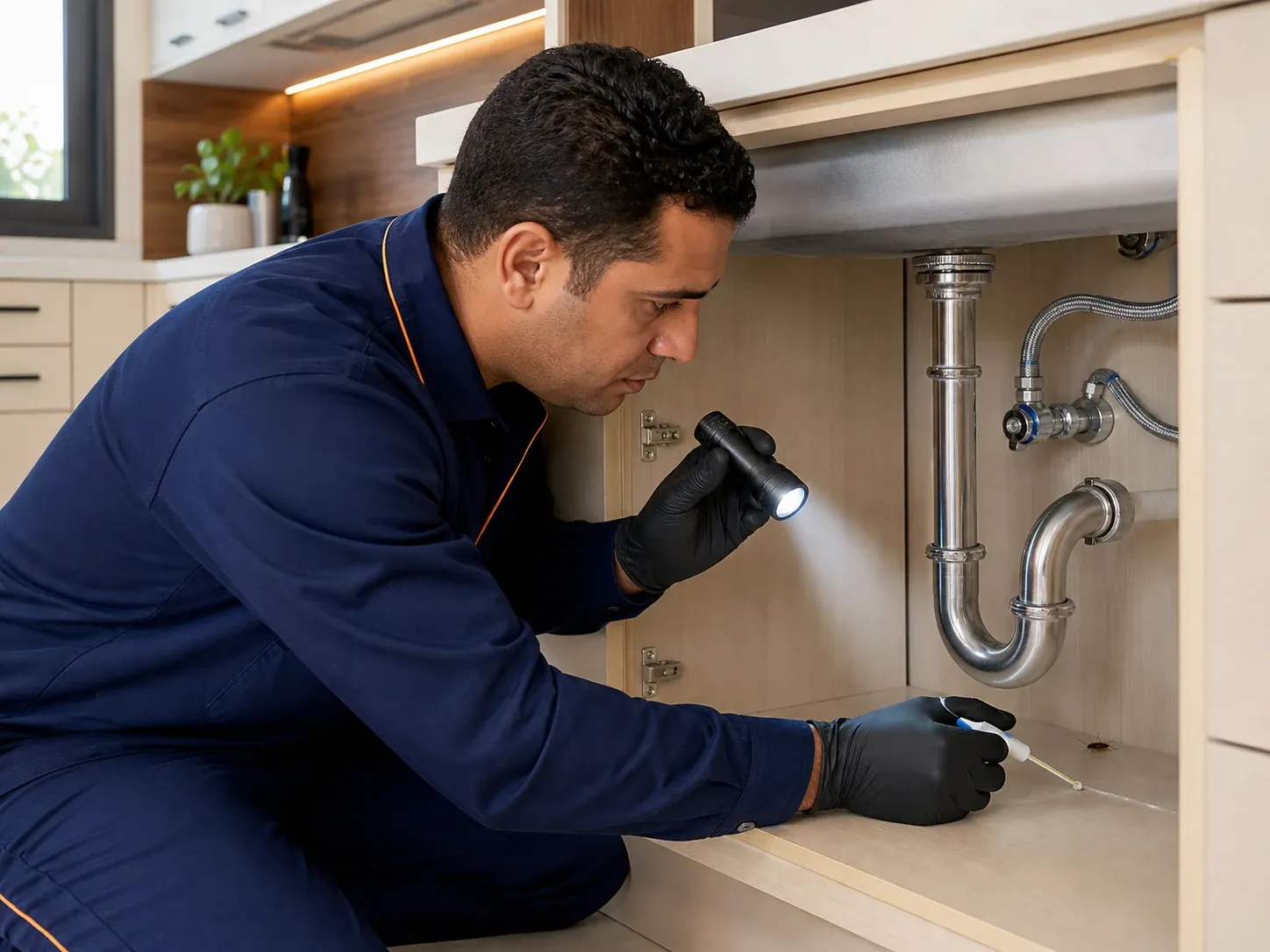
Want cockroaches gone for good? Cut off their water. Close off their food. Seal the cracks they hide in, and put gel bait inside those hiding places instead of spraying into the air. That contains the problem. Ending it takes treatment that reaches the egg cases and the colony, not just the insects you can see, backed by a written warranty up to 3 years.
Cockroaches turn up exactly where you least want them: the kitchen and the bathroom. If you have recently moved to Cairo, Alexandria or the North Coast, the humid summer here makes them far more persistent than you are probably used to.
Contents
- Which cockroaches live in Egyptian homes?
- Why cockroaches appear and spread in your home
- How to tell you have a real infestation
- What cockroaches do to your health and your children’s
- Gel or spray? What actually works in a kitchen
- How to deal with cockroaches yourself
- Why cockroaches come back after you thought you had won
- How to keep them out: cleaning and plumbing as prevention
- Common mistakes that keep cockroaches in your home
- When you need a professional pest control company
- What does cockroach control cost in Egypt?
- The bottom line
- Frequently asked questions
Which cockroaches live in Egyptian homes?
Two species dominate Egyptian homes. They hide in different places, arrive by different routes, and what works on one is close to useless on the other.
1) The German cockroach, the kitchen specialist
Small, light brown, roughly 15mm long, with two dark stripes behind the head. It is the real problem in Egyptian kitchens, not for how it looks but for how fast it breeds. A female carries an egg case, an ootheca, holding 16 to 40 eggs, and produces several in a short life. A handful that arrived in a cardboard box becomes hundreds in two or three months.
It wants warmth, moisture and food within a few steps of each other, which describes a kitchen unit perfectly: behind the fridge, under the cooker, in the cupboard under the sink, around the fridge motor. That warm gap behind the fridge is the most common nest we find, and it is exactly where a spray never reaches.
2) The American cockroach, the big one from the drains
The one that makes people leave the room. Reddish-brown and glossy, up to 40mm or more, able to fly short distances on hot nights. Locally it is called the sewer roach, accurately. It lives in drainage pipes, septic systems and dark damp corners. Think floor drains in the bathroom and kitchen, the space under the sink, the laundry area, ground floors and basements. It gets in through a drain, an unscreened window or a ventilation shaft. Unlike the German cockroach it rarely nests indoors. It commutes, and keeps commuting while the route is open.
Worth knowing: large cockroaches coming out of the drain point to your plumbing, not your kitchen hygiene. Small brown ones inside the food cupboard mean a German colony is breeding indoors, which needs a much faster response.
A third, less common species, the darker oriental cockroach, prefers cool damp basements. All three answer to the same principle: remove the water and the food, close the routes in, and get the active ingredient into the harbourage.
Why cockroaches appear and spread in your home
They do not arrive by accident. They arrive because your home offers food, water and a warm gap to hide in.
The climate is on their side. Hot humid summers, particularly in Cairo, the Delta and along the coast in Alexandria, are close to ideal breeding conditions. Heat speeds up the life cycle and humidity supplies the water. That is why numbers jump with the first real heat in May, and why a North Coast apartment shut up for a month can feel overrun the week you open it.
The kitchen is a 24-hour buffet: crumbs under the cooker, grease on the extractor, washing-up left overnight, a bin bag two days old.
Water matters more to them than food, and that is the part people miss. A cockroach can go weeks without eating, but without water it weakens quickly. The wet sink, the pipe dripping under the counter, damp around the water heater, a wet cloth on the worktop. Those are what convince an insect to settle rather than pass through.
Then there are the cracks. Older buildings in Zamalek, Heliopolis, Downtown and central Alexandria are full of perfect harbourage: gaps around pipes, loose floor tiles, the void behind a marble worktop, chipboard units, electrical back boxes. Cockroaches seek out tight spaces where their body touches a surface above and below, because that contact makes them feel safe. Newer compounds in New Cairo, Sheikh Zayed, Rehab and Madinaty have fewer cracks, but long shared service ducts move a problem sideways just as well.
Neighbours matter too. Cockroaches travel between flats through shared drainage stacks and ventilation openings, so your kitchen can be spotless and the infestation can still be arriving from the flat below. That is why treating one flat in a badly affected building sometimes buys only a few weeks.
They also hitch a ride, in a new appliance box, vegetable bags from the market, a suitcase back from a trip, or a second-hand wardrobe from the previous tenant.
How to tell you have a real infestation
One cockroach is not a disaster, but you should not wait until you have seen ten. These signs tell you it is more than a stray.
- Cockroaches moving in daylight. They are nocturnal and hide during the day. Seeing one in the open in the afternoon usually means the harbourage is overcrowded and it has been pushed out to find food and space. That is an advanced infestation, not an early one.
- Egg cases. Check the inside corners of cupboards, the back of the fridge and any deep crack for a small brown capsule, like an enlarged grain of rice. Each one is a generation waiting.
- Droppings. German cockroaches leave small black specks, like coarse ground pepper, in corners and along shelves. The larger species leaves bigger, more cylindrical droppings.
- A distinctive smell. A heavy infestation leaves an oily, musty odour inside a cupboard. If a strange smell persists after cleaning, search properly.
- Shed skins and smear marks. They moult as they grow, so you find small translucent shells, and a dark greasy line along a route they use constantly.
Find one or more of these and you are not dealing with a single insect. You are dealing with a colony, and that difference decides how you treat it.
What cockroaches do to your health and your children's
Most people file cockroaches under “unpleasant” and stop there. This is a health issue, particularly in a home with young children.
1) Food contamination
A cockroach walks through drains, bins and septic lines, and minutes later it is on your worktop and your cutlery. It can carry bacteria such as salmonella, E. coli and shigella. Those are the organisms behind food poisoning and stomach upsets, and children tend to be hit harder. The legs are not the whole story either. Cockroaches regurgitate and leave droppings while they feed, so wash anything they have crossed.
2) Asthma and allergies
Shed skins, droppings and saliva break down into fine particles that mix with house dust and stay airborne. Children breathe them in, and some react with allergy symptoms or worsened asthma. Medical research has linked cockroach allergens in the home with more frequent asthma attacks in children.
So if your child coughs at night or has allergy symptoms with no clear cause, and you also have cockroaches in the kitchen, the two may be connected. Worth raising with your doctor.
3) The other costs
- They get into flour, rice, pasta and sugar, contaminating them with droppings and odour, so the packet goes in the bin and you pay for it twice.
- People stop wanting to use their own kitchen after dark. That anxiety is real, especially when you are new to the country and already feel less in control.
- In a restaurant or a food store, one cockroach seen by a customer can damage your reputation and put your health rating at risk.
Gel or spray? What actually works in a kitchen
Aerosol from the supermarket, or gel bait? The choice genuinely changes the outcome.
1) Spray
Spray gives you an immediate result. The insect dies while you watch, and it feels like progress. It is useful in open places: drains, corners, light wells.
The drawbacks in a kitchen are real. It kills what is exposed, never reaches deep harbourage, and does not penetrate the protective egg case at all. Worse, aerosol repels: it scatters the survivors into cracks in other rooms, so the problem gets wider. The residual effect fades fast, so two weeks later the generation that hatched from untouched eggs walks back out.
2) Gel bait
Gel goes on as small dots inside the cockroach’s own hiding place: the joint at the back of a unit, behind the fridge, under the lip of the worktop, around pipe entries. The cockroach is attracted to it and feeds.
Then comes the useful part. The insect that has fed returns to the harbourage and dies there, and the rest of the colony feeds on the remains, so the active ingredient moves from one to the next without you chasing anything. The bait stays active for weeks, so when the eggs hatch it is still waiting. That is how you close the life cycle instead of killing what you can see.
For kitchens, gel is the better tool: targeted, clean, away from food surfaces, and it does not scatter the colony. Better still is combining both, with gel inside the harbourage and a targeted residual application at entry points and around drains to stop new arrivals. That is how our professional cockroach control service works. Gel and targeted product go behind the appliances and around the pipework, so the visible generation and the eggs are both dealt with. You do not have to move out of your home while it happens.
How to deal with cockroaches yourself
These steps genuinely help if the infestation is still small. Be realistic, though: home measures contain and reduce. An established colony with eggs in it is hard to finish off from a supermarket shelf.
1) Dry up every water source. The single most important step. Fix leaks under the sink, dry the sink before bed, keep wet cloths off the worktop, and lift the pet’s bowl at night. Without water a cockroach weakens fast and goes looking for a better address.
2) Close off the food. Move flour, rice, sugar and pasta into airtight containers. Wash up before bed, wipe grease off the worktop and cooker daily, and take the rubbish out promptly in a sealed bag.
3) Clean the places you cannot see. They are not living on the polished worktop, they are living under it and behind it. Clean under the cooker and the fridge, and remove the grease behind the appliances and behind the extractor.
4) Seal the cracks and openings. Use silicone or filler around pipework, under the worktop and around electrical back boxes. Fit mesh over drain and ventilation openings, and plug the floor drain at night. That stops the large drain species.
5) Use gel properly. Apply many small dots inside the harbourage, in the inner corners of cupboards, behind the fridge, around pipe entries, rather than one blob in the open. Never spray over or beside a gel placement: it repels the insects and the bait stops working.
6) Boric acid, used carefully. An extremely thin dust along hidden runways clings to the insect, which ingests it while grooming. Keep it well away from food, children and pets. A thick line gets avoided.
7) Natural remedies are support, not a solution. Bay leaves and strong mint scents irritate cockroaches and may push them out of a corner, but no colony has ever been eliminated by bay leaves.
Still seeing cockroaches two weeks later, or seeing them in daylight, or finding egg cases? The colony is bigger than a home remedy can handle.
Why cockroaches come back after you thought you had won
The most common question we get, and the most frustrating experience: gone for a few weeks, then back. Here is why.
The eggs survive the treatment. The egg case has a protective shell that shields the eggs from most surface products. You spray, you kill everything mobile, the cases sit untouched, and days later they hatch and start it again. This is the biggest reason by far.
Surface spray never reaches the harbourage. The colony sits deep inside cracks a surface application does not touch, so you kill the ones out for a stroll while the rest wait.
The entry routes are still open. If they are arriving from the drainage stack or a neighbouring flat, it does not matter how many you kill indoors. And while the food and water are still there, every cockroach that walks in finds a reason to stay and breed.
Wrong product, or wrong concentration. Some retail products are weak, and a population exposed repeatedly to the same active ingredient can develop resistance. A professional rotates active ingredients between treatments to avoid that.
Real control is not one big kill. It is a cycle that reaches the eggs and the generation hatching from them, closes the entry routes, and changes the conditions that attracted them. That is the difference between a result that lasts a month and one that holds. It is also what our written warranty up to 3 years is there to back.
How to keep them out: cleaning and plumbing as prevention
Eliminating cockroaches is half the job. The other half is making your home a place they cannot live in. Prevention is cheaper than treatment and it protects the result you paid for.
1) Smart daily cleaning
Let the sink go to bed clean and dry. That one habit does more than anything else on this list. Wipe grease from the cooker, wall and extractor, because accumulated fat is food in itself, and every few weeks clean under and behind the appliances.
2) Plumbing, the defence line everyone forgets
A large share of the problem in Egyptian homes starts in the plumbing, especially the big species that comes up out of the floor drain.
- Fix leaks immediately. A pipe dripping under the sink supplies water around the clock.
- Use plugs in the floor drains overnight, particularly kitchen and bathroom.
- Clean the sink trap and grease trap, since that fat is what they feed on.
- Check the drainage stack is sealed and there are no open gaps where pipes pass through walls.
3) Seal the entry points
Look at your home the way a cockroach would: every crack, every gap around a pipe, every hole in a window screen. Close them with silicone or filler.
4) Regular follow-up
If your home has been treated before, or you are on a ground floor, or the problem keeps returning in your building, keep a periodic check in place. Preventive treatment on a schedule is cheaper over time and catches a problem while it is small.
Common mistakes that keep cockroaches in your home
Most of these are made with the best intentions, and they all prolong the problem.
Relying on aerosol alone. It kills what is visible, scatters the rest and leaves the eggs. If that is your only weapon, they come back. It is a question of when.
Spraying over gel bait. It repels the insects from the bait and wastes it. Pick one method per location.
Laying dust or gel too thickly. They avoid anything that looks or smells wrong on their route. Boric acid and gel both need to be thin, spread as many small deposits.
Cleaning what shows and ignoring what does not. Polishing the worktop while a layer of grease sits behind the cooker achieves very little. And you can seal every food source and still leave one dripping pipe. Water alone keeps them settled.
Treating only your flat in an affected building. If the source is a shared drainage stack or the flat next door, treating in isolation gives a short-lived result. Speak to the building manager or the bawab, the caretaker who looks after the building. If language is a barrier, we can have that conversation for you.
Stopping too early. Numbers drop after a week and you assume it is finished. The generation still hatching needs the treatment active for weeks.
Using the same product every time. Populations develop resistance to an active ingredient they meet repeatedly. Knowing when to rotate is a professional judgement.
When you need a professional pest control company
Home methods are fine for a small problem and excellent as prevention. Some situations tell you clearly that this needs a professional:
- You see cockroaches during the day, so the harbourage is crowded and the infestation is advanced.
- You have found egg cases. Breeding is under way, and control has to reach the eggs themselves.
- The problem returned after you treated it yourself. The colony is bigger than a home remedy.
- Large cockroaches keep coming out of the drains. That needs the source treated, not the symptom.
- Someone at home has asthma or allergies. Their health matters more than weeks of experimenting.
- The property is a restaurant or food store, which needs a scheduled programme and records.
- A villa or a large building with many openings, hard to cover properly on your own.
A professional identifies the species and the source first. After that the product goes into the harbourage and onto the eggs, active ingredients are rotated to avoid resistance, and the drainage gets treated alongside the kitchen.
Our professional cockroach control team works that way: inspection and diagnosis, then a clear plan and a written quote before any work starts, so you know the price before anyone touches anything. Treatment uses licensed pesticides, safe around children and pets once dry, and you get a written warranty up to 3 years with follow-up visits. If the pest reappears during the warranty period, we come back and treat again under the warranty.
We have been doing this for more than 12 years, in over 8,500 homes and facilities, across all 27 Egyptian governorates. Our team includes English speakers, so you can describe the problem in your own language and understand what is being applied in your home. Response averages around 60 minutes.
To book a visit, get in touch here and tell us your area, whether that is New Cairo, Maadi, Zamalek, Sheikh Zayed, Heliopolis, Rehab, Madinaty, Alexandria or the North Coast.
What does cockroach control cost in Egypt?
The honest answer is that there is no single fixed price, because cost depends on real factors:
- The size of the property. A small flat is not a villa, and a villa is not a restaurant.
- The species and the extent of the infestation. A limited problem in one kitchen is not an established colony spread through a whole flat.
- The type of treatment. Targeted gel, residual application, drain treatment, sealing of entry points. The plan is built around your case.
- Warranty and follow-up. Treatment with a written warranty and return visits is worth more than a quick spray, and it saves money because it solves the problem once.
The cheapest option is rarely the best value. A cheap spray that lets them come back has you paying several times over.
So we will not quote a number over the phone without seeing the situation. We inspect and diagnose the property first: the species, the area, how far it has spread, and where they are getting in. Then you get a clear written quote before anything starts. You approve the price, and the decision to go ahead is yours.
The bottom line
Cockroaches in the kitchen are not just an annoyance. They contaminate your food and they can make life harder for anyone at home with asthma or allergies. The difference between them disappearing and coming back is whether the treatment reaches the harbourage and the eggs, closes the routes in, and changes the conditions that attracted them.
Start with cleaning, cutting off water and sealing cracks, and use gel bait properly rather than reaching for an aerosol. If the infestation is large, or it keeps returning, or someone at home has allergies, let a professional finish it the first time, with a written warranty up to 3 years behind it.
Your home should be somewhere you feel comfortable. Cockroaches do not get to share it.
Frequently asked questions
How do I get rid of cockroaches in my kitchen for good?
Start by cutting off food and water. Dry the sink before bed, seal the cracks under the counter and behind the fridge, and place small gel bait dots inside the hiding places. That contains the problem. Ending it means reaching the egg cases and the colony, which is what professional treatment with a written warranty does.
Why do cockroaches come back after spraying?
Because spray kills what is walking in the open and leaves the egg cases untouched inside cracks. One case holds 16 to 40 nymphs waiting to hatch. Aerosol also scatters the survivors deeper into the flat. Lasting control needs a residual bait that is still working when the next generation emerges two weeks later.
What is the difference between gel bait and spray?
Gel is placed as small dots inside the cockroach’s hiding place. It feeds, returns to the harbourage and dies there, and the rest of the colony feeds on the remains, so the active ingredient spreads without you chasing anything. It keeps working for weeks. Spray covers surfaces and kills on contact but fades fast. Kitchens suit gel.
Are cockroaches dangerous for children?
They can be. Cockroaches travel through drains and bins before crossing your worktop, and they can carry bacteria such as salmonella and E. coli. Their shed skins and droppings also break down into household dust, and research has linked those allergens to more frequent asthma symptoms in children.
What does cockroach control cost in Egypt?
Price depends on the size of the property, the species, and how far the infestation has spread. A flat costs less than a villa or a restaurant. We inspect and diagnose the place first, then give you a clear written quote before anything starts, with no hidden fees, and you decide whether to go ahead.
Are the pesticides safe around children and pets?
We use licensed pesticides, safe around children and pets once dry, which takes about two hours. The gel itself goes in small hidden dots inside cupboards and behind appliances, well out of reach of small hands. You get simple written instructions for what to do before and after the treatment.
When should I call a pest control company?
Call when you see cockroaches during the day, when you find brown egg cases in the corners of cupboards, when the problem returns after you have treated it yourself, or when the property is a restaurant or food store. In those cases the colony is beyond any home remedy and needs treatment that reaches the eggs.
How long does it take for cockroaches to disappear after treatment?
You should see numbers drop clearly within the first 3 to 7 days. Full control usually takes two to four weeks, because the bait has to stay active while each batch of eggs hatches and feeds on it. That is why follow-up visits and the written warranty matter: they confirm the cycle is closed.