

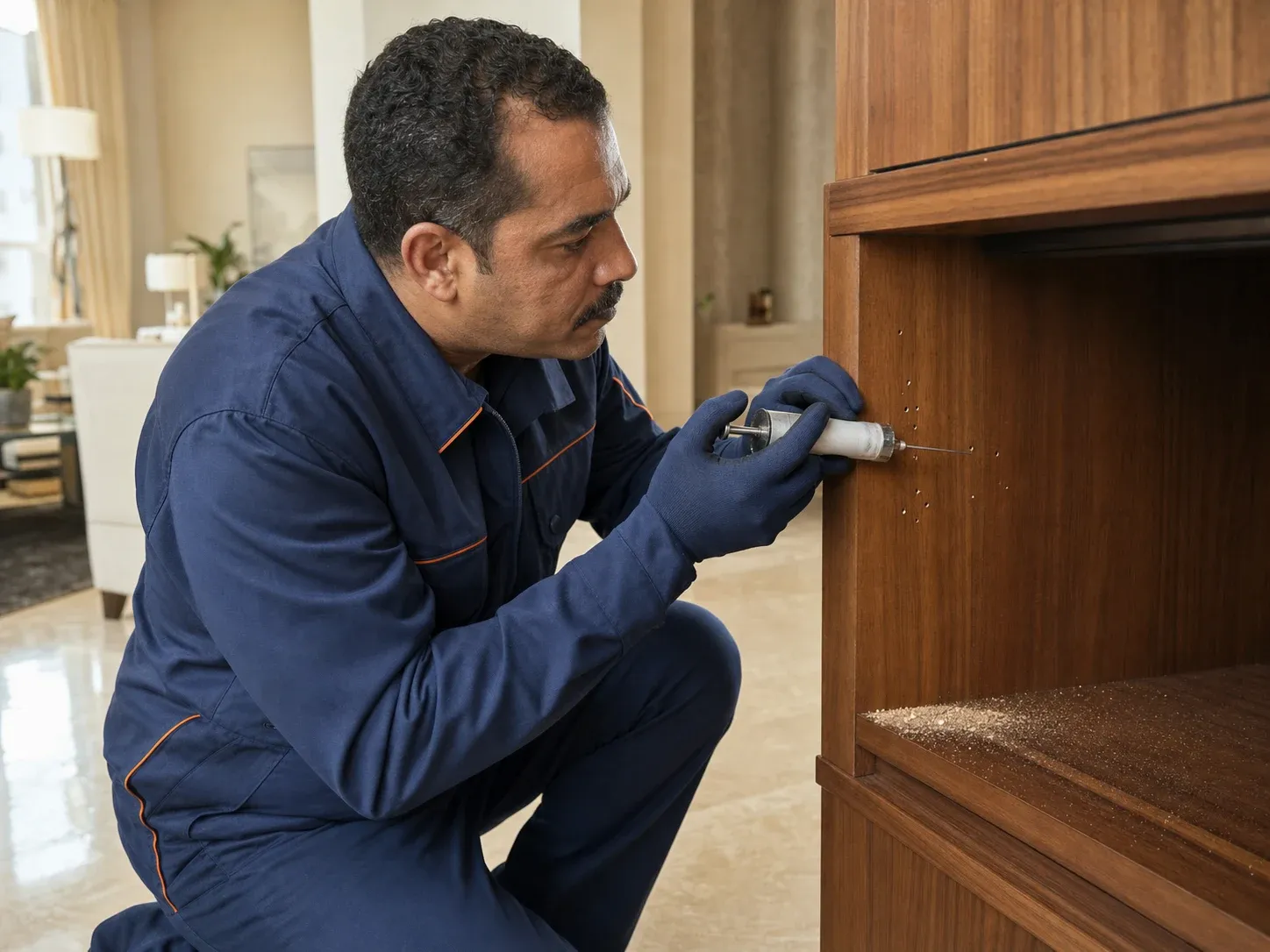
Woodworm and termites eat wood from the inside out, quietly, for months. You usually find out the day a door frame or a chair leg gives way in your hand. Three signs give them away: fine powder like flour under the furniture, small round holes in the surface, and a faint chewing sound in a silent room at night. Home remedies barely reach past the varnish. Clearing an infestation means getting product deep into the timber, where the larvae actually live.
Of every pest that gets into a home in Egypt, this is the one that costs you real money. A cockroach is unpleasant. Mosquitoes ruin one night’s sleep. Woodworm works in the dark for years, while you walk past the same wardrobe every morning and notice nothing. By the time you do, the furniture is finished, or the door is, or a wooden ceiling in an older building.
If you rent a furnished flat in Zamalek, Maadi, Garden City or Heliopolis, this matters twice over. Those buildings are often 60 to 80 years old, and the doors, shutters, parquet and sometimes the ceiling beams are original timber. Damage to any of it becomes a conversation with your landlord at the end of the lease, and you want that conversation early.
Contents
- What is the difference between woodworm and termites?
- How to tell if you have woodworm: the early signs
- Which species do you get in Egypt?
- What woodworm actually costs you
- Home remedies for woodworm, and where they stop
- How professional injection treatment works
- How to stop it coming back: buying furniture safely
- When to call a specialist straight away
- What does woodworm treatment cost?
- Frequently asked questions
What is the difference between woodworm and termites?
People mix these two up constantly, and it matters, because the treatment changes completely.
Woodworm is not really a worm. It is the common name for small beetles that lay eggs in a crack or an open grain on the surface of timber. The eggs hatch into larvae, and the larva is the real character here: it bores into the wood and tunnels through it, feeding from the inside for years. When it matures it becomes an adult beetle, chews its way out and leaves the small round exit hole everyone recognises.
Termites are a different story. They are social insects, like ants, living in colonies with a queen, workers and soldiers, and a colony can run into the millions. The nest is usually hidden in the soil under the building, and the workers travel out, collect wood and carry it back. That is why they reach places ordinary woodworm never gets near. They travel from a ground floor slab up to the doors and ceilings of the top floors, moving inside the walls through mud tunnels.
They are also far faster. Woodworm may take years to destroy a wardrobe; termites can hollow out a door frame in months, and if they reach structural timber, you are no longer discussing furniture.
In short: holes and powder on a wooden item are almost always woodworm. Mud tubes on a wall, or pale insects out of a crack in the floor, are termites. Both need treating; termites do not wait.
How to tell if you have woodworm: the early signs
Catching it early saves you the furniture. These insects leave evidence. You only need to read it.
1) The powder, known as frass
As the larva eats it pushes out very fine waste, the texture of flour, pale yellow to light brown. You find it in a small heap under a piece of furniture, on the floor beneath a door, or along a shelf.
Do this test. Wipe it away and note the date. If a fresh heap has formed a day or two later, the infestation is active right now.
2) The holes in the surface
The holes are exit doors, made by adult beetles chewing their way out, not by insects going in. They are small, from a pin head to a lentil. Pale, clean edges with powder nearby mean an active infestation; dark, dusty edges usually mean old damage, though there is often live activity in a piece nearby.
3) The sound
At night, in a quiet flat, put your ear close to a badly affected piece and you may hear a faint ticking. That is the larvae. With termites, tap a suspect door or beam: a hollow, papery sound means the inside has gone.
4) Wood that looks perfect but crumbles under your finger
Press firmly with your thumb, or a screwdriver tip, on a spot you are unsure about. If it sinks in or breaks up like cardboard, the piece is hollow inside.
In an Egyptian flat the first casualties are almost always the internal doors and the wooden shutters. After that, the legs of sofas, beds and wardrobes, which sit close to the floor where the humidity is. In a ground floor flat or a villa with a garden, check the skirting too.
5) Signs that mean termites specifically
- Mud tubes. Thin lines of packed soil running up a wall, along skirting, or behind furniture. Termites build them to travel shielded from air and light. Conclusive.
- Discarded wings. Often after the first rain, a colony releases winged adults that fly, mate and shed their wings. A pile of identical transparent wings near a window or under a light is a serious warning.
- Pale, cream coloured insects coming out of a crack in the floor or wall, especially if you break open a mud tube and find them inside.
A practical habit: ten minutes a month, under the older wooden furniture, behind the wardrobes and along the bottom of the internal doors. That is the whole routine, and it is what keeps one affected item from becoming a whole-property job.
Which species do you get in Egypt?
Not everything that eats wood behaves the same way, and the species decides the treatment.
Woodworm beetles
- Common furniture beetle. The one in most homes. It likes older furniture and dry, seasoned timber, and leaves the classic small holes and floury powder. Slow but stubborn, cycling through the same piece for years.
- Powderpost beetle. Goes for newer timber with a higher starch content, and its frass is extremely fine. It reaches modern furniture and works faster.
- Larger wood boring beetles. Wider holes, bigger tunnels, a preference for damp timber. They turn up where there is a leak: a wardrobe built into a wall, or timber against a north facing wall that never dries.
Termites
- Subterranean termites. The most damaging and most widespread here, particularly where the soil is damp or close to canals and farmland, and in older houses and villas sitting on the ground. The colony lives in the soil and reaches the building through the foundations. This is the one that destroys doors, ceilings and structural timber.
- Drywood termites. These live inside the timber itself and need no soil contact, so you find them in a single piece of furniture or a beam on a high floor. They leave small hard pellets, closer to coffee grounds than to powder.
Why Egypt suits them so well
Heat and humidity are ideal for both, and the long Egyptian summer speeds up the life cycle, so larvae mature and colonies expand faster than in a cooler climate. Coastal humidity is why Alexandria, Damietta and Port Said see more of it, and the same goes for a North Coast chalet shut for eight months and opened in June.
In the Delta and Upper Egypt, high groundwater and agricultural soil make subterranean termites common. The new compounds have a modern version of the same problem. Much of New Cairo, Sheikh Zayed, 6th of October, Rehab and Madinaty sits on reclaimed farmland, and compound gardens are irrigated daily. Permanently moist soil against a villa’s foundations is exactly what a colony wants. Older Cairo is the other side of it: Downtown, Zamalek, Heliopolis and Garden City are full of timber ceilings, doors, shutters and parquet above damp ground floors.
What woodworm actually costs you
Other pests are unpleasant. This one turns straight into a bill.
1) Expensive furniture turns into scrap
The dining set you paid a lot for, the antique bed from Khan el Khalili, the wardrobe built to fit the room. All favourite targets, and the cruel part is that the piece looks fine right up to the moment it collapses. Repairing it often costs close to replacing it, and an antique loses its value for good.
2) Doors and shutters
Doors and shutters are the most commonly affected items in a home here, especially internal doors and the ones facing the stairwell. A hollowed door fails at the hinges, becomes hard to close, and can drop out of its frame. Replacing one means the leaf and the frame together, multiplied by every door in the flat.
For a tenant there is an extra layer. Doors and shutters in an old Zamalek or Maadi building are original and hard to match. Agreeing with your landlord early about who handles the treatment is simpler than arguing when you hand back the keys.
3) Ceilings and structural timber
Older houses and villas have timber ceiling beams, sometimes whole wooden ceilings, and wooden balustrades. If subterranean termites reach those, it stops being about money and becomes about safety. A sagging ceiling or a balustrade that gives way is a real risk to everyone in the house.
4) Parquet and wooden flooring
Good parquet is expensive, and if woodworm or termites get underneath, it hollows out from below and sinks under your foot. Repairing it usually means lifting the whole floor.
5) The cost nobody adds up: spread
The adult beetle flies and lays eggs on whatever wood is nearby, so the infestation walks from the door to the wardrobe to the bed. Leave it, and one contained treatment becomes a whole property.
Every day it stays active, more timber is eaten and the bill grows.
Home remedies for woodworm, and where they stop
It is natural to reach for a home fix first. These have a limited role, and knowing where they stop saves you time and money.
- Kerosene. Plenty of people brush kerosene onto affected wood. It kills what is at the surface, but it barely penetrates, and the larvae live in the heart of the timber. It ruins the finish, the smell lingers for months, and it is flammable, which is not what you want soaked into furniture in a home with children.
- Vinegar, salt and borax. These circulate widely online. They are far too weak to penetrate timber and reach the tunnels. They may clean a surface, but they will not touch a larva deep inside.
- Supermarket sprays. Aerosols work on insects they touch. Woodworm is not out in the open, so the spray treats the surface and nothing else.
- Sunlight. For a small item like a chair, several hours in strong sun kills some larvae near the surface. Not practical for a fitted wardrobe or a hung door, and it does not reach depth.
- The freezer. A picture frame or small ornament can go in for a few days and the larvae die. Useless for anything larger.
One more thing, because it comes up constantly with people new to Egypt. Someone will offer to spray your flat for very little, using an unlabelled product in an unmarked container, with no paperwork. Do not accept it. Ask any company what they are applying, what the safety instructions are, and when rooms can be used again. A serious company answers all three without hesitating.
Why do these approaches fail to finish the job?
The reason is always the same. The insect lives deep inside the wood, and home remedies reach the surface. Anything that does not get into the larval tunnels leaves a new generation to mature, emerge and lay eggs. So the problem eases for a couple of weeks, then returns as the generation already inside the timber comes out. That is where “I tried everything and it came back” comes from.
Use them as a holding action until a specialist arrives. If the signs are clear, do not spend weeks experimenting. The timber is being eaten the whole time.
How professional injection treatment works
Professional treatment rests on one idea: get the product inside the wood, into the tunnels where the larvae are, not onto the surface.
1) Inspection and diagnosis
A technician goes through the whole property, not just the piece with obvious damage. We identify the species, how far it has gone, which items are affected and which nearby ones are at risk. This matters more than the treatment itself, because one untreated piece left behind means the problem returns. With subterranean termites we also find the entry point from the soil. You get the findings in plain language, in English, and a clear written quote before anyone touches anything. You approve the price first.
2) Injection into the timber
This is the heart of it. We drill fine, carefully spaced holes and inject a liquid product under pressure, so it spreads through the tunnel network and reaches the larvae in the core. It kills what is inside and leaves a residue that stops newly hatched larvae surviving. The holes are small and are filled afterwards, so the piece looks the same.
We use licensed pesticides, safe around children and pets once dry, and you get simple instructions: what to cover, when to ventilate, and when each room can be used again. If anyone at home has asthma or an allergy, tell us before the visit.
3) Protective surface treatment
The exposed timber is then treated with a protective product, so that if an adult beetle lands and lays, the eggs do not survive. This stops a new cycle beginning.
4) Treating subterranean termites
If the termites are coming up from the soil, the work goes deeper. We put a chemical barrier in the soil around the foundations and at the entry points, so any termite crossing into the building passes through treated soil. Sometimes we use bait instead: the workers carry it back to the queen, which collapses the colony at source. It is precise work. Termites find any gap in a barrier and come straight back through it.
5) Written warranty and follow-up
This is where serious work separates itself from a quick spray. At Almanya Zed Pest Control, woodworm and termite treatment carries a written warranty up to 3 years.
Why three years? The life cycle of these insects is long, and surviving eggs take time to show themselves. A warranty that long means we are confident the treatment was complete, and if activity appears again inside the period, we come back and treat the property without charging you a second time.
If you want someone to look at the property and tell you what you are dealing with, get in touch here and we will arrange an inspection visit anywhere in Egypt. Our team speaks English, so you can explain the problem and follow the plan without a translator.
How to stop it coming back: buying furniture safely
Prevention is cheaper. Most infestations arrive inside furniture or timber that was already affected before it came through the door.
Whenever you buy furniture, new or second-hand
- Inspect it before it comes into the house. Every surface, the underside, the hidden corners at the back, looking for small holes and powder. Second-hand furniture and antiques carry far more risk, because they can be carrying a dormant infestation nobody noticed.
- Be careful with untreated timber. Some furniture is made from wood that was never treated against borers at the factory. Ask, and if you cannot get a clear answer, have the piece treated preventively.
- Quarantine anything you are unsure about. Leave a second-hand piece on a balcony or in an empty room for a few weeks and watch it. If powder appears, you caught it in time.
The same check applies to a shipped container from abroad, a new set from Damietta, and antiques from a dealer in Old Cairo. If you are taking over a furnished rental, check the landlord’s furniture during the walkthrough, before you sign, so existing damage is on record.
Around the home generally
- Control the damp. Both love moisture. Fix leaks quickly, ventilate older rooms and basements, and do not leave wood pressed against a damp wall.
- Do not store timber or cardboard on the floor for long periods, especially on a ground floor or in a storeroom. Stacks of paper and offcuts are a perfect nest.
- Leave an air gap between furniture and damp walls so air can move and moisture does not collect.
- Watch the older doors and windows. The first thing affected in most Egyptian flats. At the first sign of powder, act rather than postpone.
- If the property sits empty for long stretches, a North Coast chalet or a place you use a few months a year, have someone open and air it.
If you are building or fitting out
If you are installing new timber in a ceiling, doors or parquet, treat the wood before it goes in. For a ground floor flat or a villa, put a termite barrier in the soil at the same time. It costs a fraction of treating a problem later.
A periodic inspection routine
If you own valuable furniture, live in an older building with a lot of timber, or have a villa in contact with the ground, book a scheduled inspection. It catches an infestation while it is small, which means the cheapest treatment. That is what our woodworm and termite control team provides: inspection, treatment if needed, follow-up under a written warranty.
When to call a specialist straight away
Some signs mean you should stop experimenting and stop waiting.
- Powder that reappears every day after you wipe it away. The clearest evidence of live activity.
- Holes increasing in number, or holes with pale, freshly cut edges.
- Mud tubes on walls or furniture. Conclusive evidence of subterranean termites, the most damaging of them.
- Piles of discarded wings near windows or lights, meaning a colony is spreading.
- A door or shutter gone hollow inside, sounding papery when you knock or sinking under light pressure.
- Damage to anything structural, a timber ceiling, a beam, a balustrade, parquet. A safety issue, not a financial one.
- More than one affected item, meaning it has already begun to spread.
The rule is simple. If it is growing, if it has spread, or if anything structural is involved, call a specialist. Woodworm is one of the few pests where every week of delay costs you money directly.
What does woodworm treatment cost?
A fair question, and the honest answer is that it varies. Nobody can give an accurate number before seeing the property. What we can do is explain what sets the price.
What determines the cost
- The species. Ordinary woodworm in one piece of furniture is one job. Subterranean termites in the foundations is another, needing soil treatment, a barrier and sometimes baiting.
- The size of the infestation. One affected piece is not the same as five spread through a flat.
- Floor area and property type. A flat, a villa and a warehouse are different jobs.
- How far it has gone. An infestation caught early is simpler and cheaper than one that has spread.
- The type of timber. Fine furniture and antiques need slower, more careful work.
How we set the price
We inspect the property first and identify the species, the area and the extent of the infestation. Then you get a clear written quote before we start, with no hidden fees, and you decide whether to go ahead. There is no honest fixed price for a service that differs this much between homes, and anyone quoting a firm figure over the phone is guessing.
The point to take away
The real cost is not the treatment. It is the furniture, the doors and the ceilings being eaten every day you postpone it. With a written warranty up to 3 years, you treat it once and stop thinking about it.
The short version
Woodworm and termites cost you money quietly. Two things decide how this goes: finding it early, and treating it properly the first time. Watch for the powder, the holes and the sound, check furniture before it enters the house, and keep the damp under control. If you find an active infestation, do not lose weeks on kerosene and vinegar. They only reach the surface. The insect lives deeper in.
We work across all 27 governorates, and our team speaks English. If you have a doubt about your furniture or your doors, let us look and tell you what you are dealing with.
Frequently asked questions
What is the difference between woodworm and termites?
Both eat wood from the inside, but they are different insects. Woodworm is a small beetle whose larvae tunnel through furniture and doors, leaving holes and fine powder. Termites are social insects living in colonies of millions. They eat far faster and travel from the soil under the building up to the top floors, so the treatment is different.
How do I know if I have woodworm in my home?
Look for three things: fine powder like flour collecting under furniture or below a door, small round holes in the wood surface, and sometimes a faint ticking or chewing sound at night. Wipe the powder away. If it comes back within a day or two, the infestation is active right now, not old.
Do home remedies get rid of woodworm for good?
No. Kerosene, vinegar and supermarket sprays only reach the surface, and the larvae live deep inside the timber. The problem can look better for two weeks, then return when the generation inside emerges. Clearing it properly means injecting product into the tunnels inside the wood, which is specialist work.
Does woodworm spread from one piece of furniture to another?
Yes. The adult beetle flies and lays eggs on any nearby wood, so an infestation moves from the door to the wardrobe to the bed if it is left alone. Treatment has to cover the whole property, not only the piece with visible damage, and any affected item is best isolated until it is treated.
Do termites eat concrete and brick?
No, they feed on wood and cellulose only. But they find their way through cracks and travel alongside brick and concrete to reach timber, moving inside walls through mud tubes. That is why you can see them coming out of a gap in a ceramic floor when the colony is actually in the soil under the building.
How much does woodworm treatment cost in Egypt?
It depends on the species, the size of the infestation, the floor area and how many items are affected. A flat with one damaged piece is one job, a villa with termites in the foundations is another entirely. We inspect first, then give you a clear written quote before we start, with no hidden fees.
Is there a warranty if the woodworm comes back?
Yes. Woodworm and termite treatment carries a written warranty up to 3 years. If any activity appears again inside that period, we come back and treat the property without charging you a second time. Woodworm returns when treatment was incomplete, and the warranty is what protects you from that.
When should I call a specialist straight away?
Call quickly if the powder comes back every day, if the number of holes keeps growing, if you see mud tubes on a wall, or if a door sounds hollow when you knock on it. All four mean the infestation is active. Every week of delay means more timber eaten and a higher cost later.